
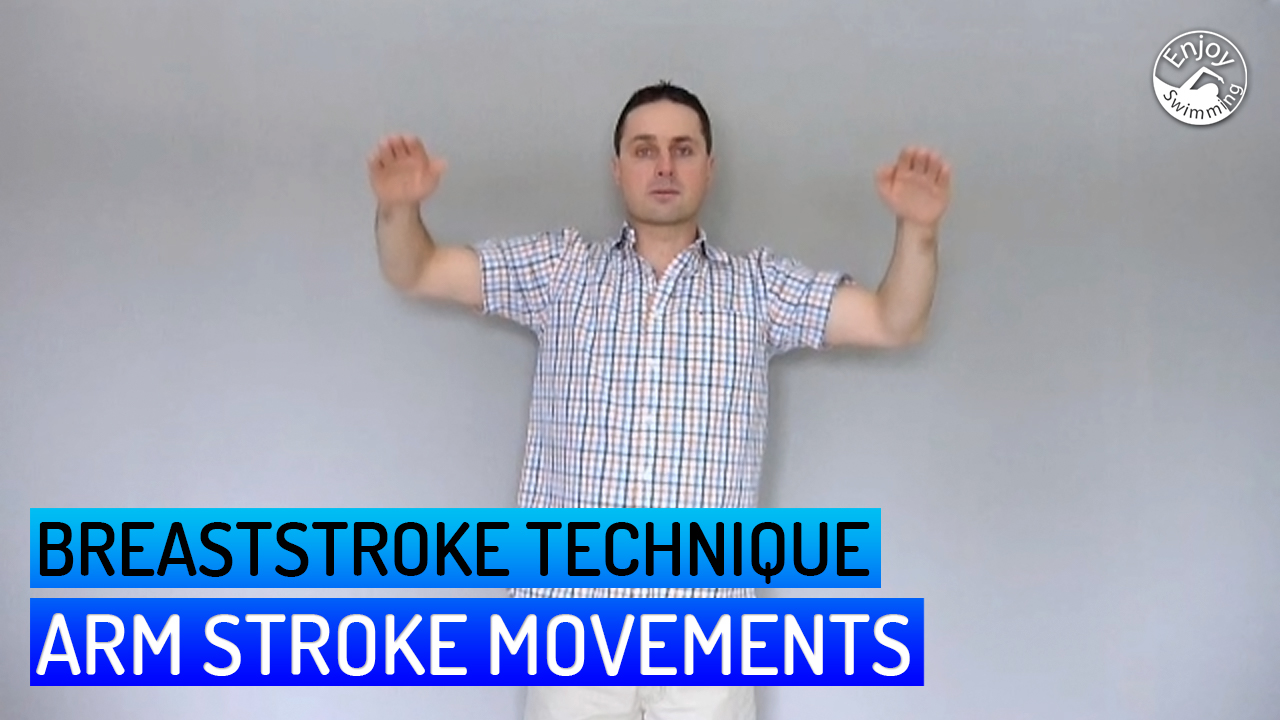
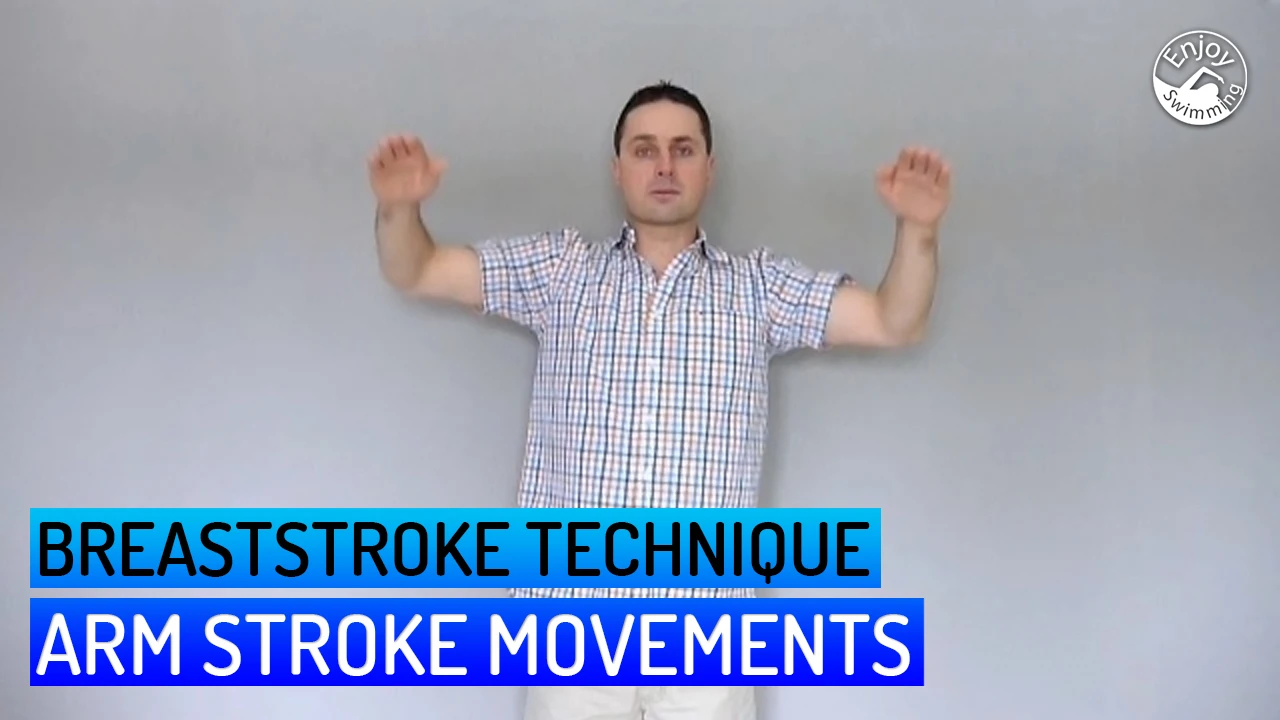
This breaststroke swimming article explains and demonstrates the arm stroke movements on dry land.
By following along, you can practice the arm stroke at home without having to worry about the other aspects of the swim stroke.
Video Demonstration
To get started, watch the following video:
Additional details about the different phases of the arm stroke are given below:
Initial Position
While swimming breaststroke, there’s a short glide phase that is observed at the end of each stroke cycle.
To start our discussion, we consider that the initial position of your arms matches the position of your arms during the glide phase.
In that glide phase, your arms (and your legs) are fully extended, and your body is horizontal and streamlined.
So assume the following position:
- Stand upright, with your arms straight and extended overhead.
- Keep your hands close together and your palms facing downwards.
Please note: The arm positions and directions given here and below are relative to your body, as if you were horizontal in the water, swimming breaststroke.
Outsweep
The breaststroke swimming stroke cycle begins with the outsweep:
- Your hands separate and your arms move outwards until they are outside the shoulders.
- Your palms should be facing downwards or slightly outwards.
Catch
During the catch, your forearms and palms move into a backward facing position, ready to apply propulsive force. So do the following:
- Bend your arms at the elbows and move your forearms downwards and backward.
- Your hands stay in line with your forearms and your shoulders stay close to the water surface.
- The catch phase ends when your forearms and palms are facing backward, perpendicular to the water surface.
Insweep
The insweep is the propulsive phase of the arm stroke. So do the following:
- Move your forearms backward and inwards while trying to keep them facing backward for as long as possible.
- Your elbows automatically move inwards towards the rib cage and your hands move towards each other.
- The insweep ends when your hands are close together below your chest.
Recovery
Your arms move back to their initial position during the recovery:
- Move your arms quickly forward in a straight line until they are completely extended, with your hands close together.
- Your forearms and palms rotate outwards during the recovery until they are again facing downwards at the end of the recovery.
Breathing Technique
Once you have memorized the movements of the arm stroke, you can integrate breathing. What you need to do is to inhale during the insweep and exhale continuously for the rest of the stroke cycle.
In fact, in breaststroke swimming, your head and shoulders rise above the water surface during the insweep, which allows you to breathe in.
Then during the arm recovery forward your head and shoulders drop back into the water, and you start to exhale and continue to do so until the next insweep.
Conclusion
Once you have practiced the arm stroke movements at home and internalized them, you can read our follow-up article that shows you how to practice the arm stroke at the pool. Have fun!
Learning Path for the Breaststroke
Below is an overview of our series of articles on learning the breaststroke. Each article in this series contains one or more drills that have to be mastered. The current article is highlighted:
Once you have gone through all the steps of this learning path, you should be able to swim breaststroke without any problems.
Good luck!
Pragya
Wednesday 13th of June 2018
Hi,
I am trying to attempt the breaststroke these days, but it becomes very difficult for me to coordinate arm and leg movements. I have asked the coach to help and watched videos, but it doesn't seem right. I will explain how I am doing it.
As I start, I pull my legs inside and do the frog kick. After I bring my feet together and they are straight I move my hands to take a breath. Most of the times I do not know what to do with my legs when I am up to breathe, and sometimes I lose balance and tilt. Other times I feel pressure in my back.
I have seen some videos, and while they breathe, they immediately start their kick phase which I am unable to coordinate. My coach tells me what I am doing is fine, and I should practice, but I don't feel confident enough.
Please help.
Christophe
Thursday 14th of June 2018
Hi Pragya,
If you can do the arm and leg movements separately, but you can't yet coordinate both, then I would agree with your coach, and it is simply a matter of patience and practice.
At some point, your body will "get it", and you'll be able to coordinate arms and legs without thinking about it.
Good luck.
Khalid Javed
Friday 14th of July 2017
This article very nicely explains the parts of the arm movements in breaststroke I wanted to learn about. Now I will apply this information and give feedback.