
In the butterfly stroke, the arms perform the same movements simultaneously.
Viewed from above, each arm traces an s-shaped path in the water from the extended forward position to the hip. (If you consider both arms, the shape looks like a keyhole pattern.)
The arms are brought forward from the hips in a semicircular movement sideways over the water. Finally, the arms dip into the water in front of the body, and a new butterfly stroke cycle begins.
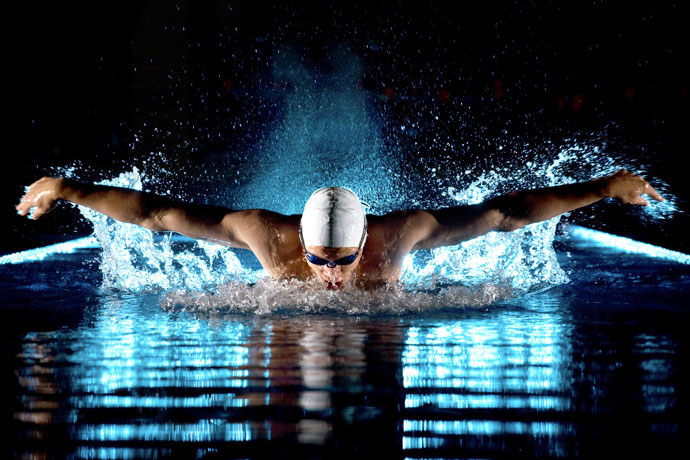
Butterfly Video
In the following video featuring Michael Phelps, we can observe the arm movements of the butterfly stroke..

Arm Stroke Phases
The butterfly arm stroke can be divided into the following phases:
- Entry and extension forward
- Outsweep and catch
- Insweep
- Upsweep
- Release
- Recovery
A detailed description of each phase follows.
Entry and Extension Forward
At the end of the above-water recovery, the arms enter the water in front of the body, either fully extended or with slightly flexed elbows.
The arms should be shoulder-width apart, or slightly less, during the entry. The palms of the hands are either facing downward or downward and a bit outward.
After entering the water, the arms extend forward for a short time while the chest is being driven downward and forward by the first dolphin kick.
Outsweep and Catch
After the downbeat of the first dolphin kick, the arms transition from the extended forward position to one where the undersides of the arms and the palms of the hands are facing backward.
To do so, after extending the arms forward, the hands sweep outward, downward, and backward. Simultaneously, the elbows bend so that they can stay high in the water, close below the water’s surface (the so-called high-elbow position, also known in the front crawl).
The swimmer should not push against the water during the outsweep; this phase is simply intended to bring the arms into position for the subsequent insweep phase of the arm stroke.
The outsweep ends in the catch position, with the arms outside the shoulders, the elbows flexed about 90° and high in the water, and the undersides of the arms and the palms facing backward.
Insweep
The insweep is the first propulsive phase of the butterfly arm stroke. The hands sweep inward, backward, and upward, from outside the shoulders to below the chest.
The elbows remain locked so each arm moves like a paddle against the water.
At the end of the insweep, the hands are close together below the chest, and the elbows are close to the rib cage.
Upsweep
The upsweep is the second propulsive phase of the butterfly arm stroke. The hands move from below the chest toward the hips.
The palms rotate from facing backward, inward, and upward to facing backward, outward, and upward.
The swimmer should keep his elbows mostly bent during the upsweep, allowing him to keep his forearms and palms facing backward as long as possible.
Consequently, during the upsweep, the elbows move a little away from the rib cage, while the hands move toward the hips.
The backward orientation of the forearms and hands cannot be maintained at the end of the upsweep, when the hands approach the hips.
Thus, at this point, the swimmer should stop pushing against the water, as otherwise water would be pushed upward instead of backward, causing the hips to sink.
However, the swimmer should try to maintain the momentum of the arms to facilitate the subsequent release and recovery.
Release
The release occurs during the downbeat of the second dolphin kick, when the shoulders are above the water’s surface, and the hands are close to the hips.
The arms leave the water with the elbows still flexed to a certain degree. The shoulders leave the water first, followed by the elbows, the forearms, and finally the hands with the palms facing inward.
Moving the arms out of the water in this manner creates the least amount of drag.
Recovery
During the recovery, the arms move sideways and in a semicircular motion from the hips to the position in front of the body.
The palms face inward, then upward, and then progressively rotate until they face downward at the end of the recovery.
As mentioned above, maintaining the momentum of the arms at the end of the upsweep helps recover the arms forward.
While the elbows are always flexed at the beginning of the recovery, some swimmers fully extend their arms later. In contrast, others maintain slight flexion of the elbows.
Finally, a new stroke cycle can start with the entry and extension forward once the arms have been brought forward.
Additional Tips
- Only push against the water during the propulsive phases of the arm stroke, which are the insweep and upsweep.
- Consequently, the velocity of the hands is also highest during the insweep and upsweep phases.
- The recovery of the arms forward should be swift, but you should also try to relax your arms during this phase to avoid early fatigue.
Related Pages
You may also be interested in the following articles that cover the butterfly stroke’s swimming technique:
Karen Milostic
Monday 18th of November 2019
Hi Christopher. I have a 12 year old son who loves swimming, his favorite stroke is butterfly. We travel to swim carnivals every second weekend so he can compete and some are over 300km’s away. He loves your photo of butterfly, the first one on your site and I want to know if I can purchase it so I can enlarge it on put it on his wall. I would really appreciate your help. Thank you from a very supportive mum.
Christophe
Monday 18th of November 2019
Hi Karen,
I bought that photo from iStockPhoto: https://www.istockphoto.com/be/en/photo/perfect-butterfly-stroke-gm459214425-31905450.
I see there are a few sizes available, so hopefully you'll be able to buy a version that prints out well.