
When swimming breaststroke, it is essential to position your head and body correctly because it allows you to swim efficiently and also protects your neck from overuse injuries.
That’s what we’ll discuss in the following article.
Swimming Breaststroke with the Head in a Neutral Position
In the regular breaststroke style, the head is kept in line with the trunk all the time. When breathing, the body is in an inclined position like you can see in the picture below:
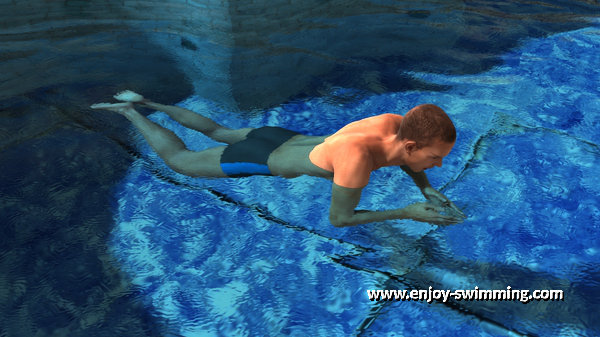
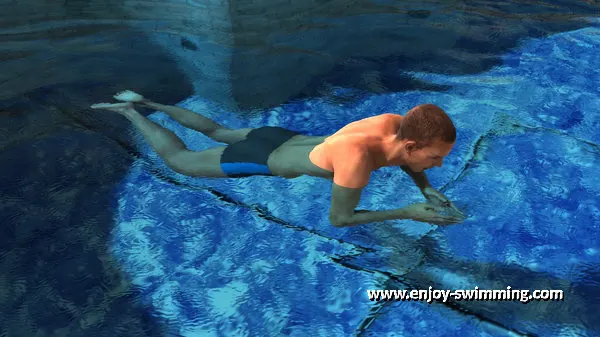
When breathing in, you should avoid looking towards the end of the pool, as this strain the neck unnecessarily:
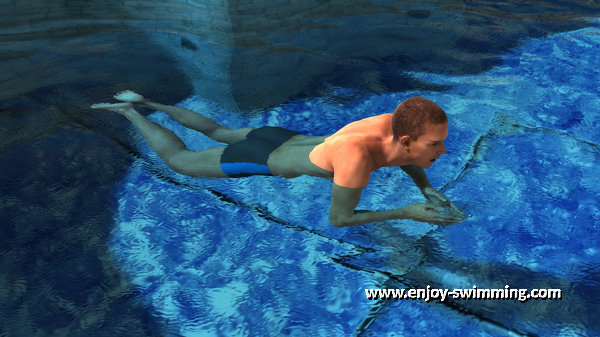
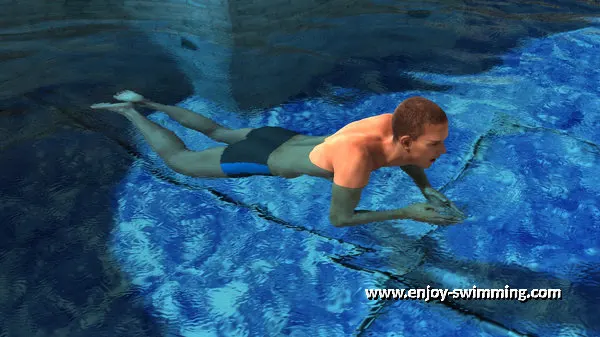
After breathing in, the body returns in a streamlined horizontal position with the head in the water, eyes looking down. That’s how fitness and competitive swimmers swim breaststroke.
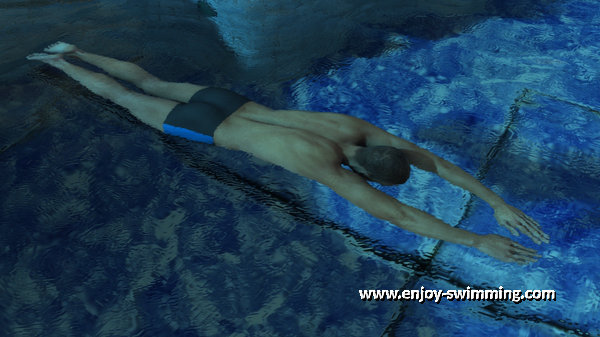
Swimming breaststroke using this regular style allows you to streamline your body and swim faster. It also protects your neck because you can keep your head in a neutral position at all times.
One aspect of swimming breaststroke efficiently is spending the right amount of time in each position. You should try to get into the streamlined position as quickly as possible after breathing in.
You should also try to keep that horizontal position for a moment during the glide, but not for so long that you come to a standstill.
Stroke Cycle in Regular Breaststroke
We will now describe in more detail what happens during the stroke’s cycle. Let’s take the gliding phase as the starting point:
- You glide in a horizontal position. Your arms are extended forward, and your legs are held close together, toes pointed.
- Your head is in line with the spine, your face is in the water, eyes looking down.
- Your arms sweep outward and then backward. Your body is still horizontal.
- Your arms sweep inward, and your hands move towards each other. At the same time, your head and shoulders rise above water while your hips go down and your feet move towards your buttocks.
- You take a quick breath as soon as your mouth clears the water.
- While your head and shoulders are above water, your head is still in line with the trunk. As your body is now in an oblique position, you look down and slightly forward.
- Your recover your arms forward just below the water surface. As a consequence, your head and shoulders drop back down in the water.
- Simultaneously, your legs kick outwards and backward, and your hips move towards the water surface.
- Once your arms and legs are completely extended you find yourself on your chest in a horizontal position again.
- You glide for a short moment before beginning the next stroke cycle.
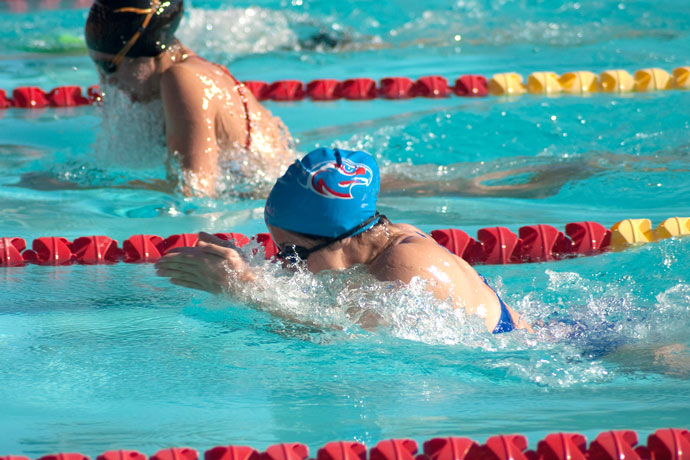
Image courtesy of KristinLaura
Swimming Breaststroke with the Head Above Water
Generations of swimmers have learned to swim this way. I did so as a child. You swim on your chest in an inclined position all the time so that you can always keep your head above water.
This breaststroke style certainly has its advantages: it allows you to breathe without constraints and you can quickly orient yourself, for example in open water.
It is possible to swim without goggles, and with some care, you can even keep your hair dry.
But swimming breaststroke this way also has its drawbacks. For one, the position of your body creates lots of drag, so it is difficult to swim fast.
You also have the tendency to look towards the pool wall, which as previously discussed strains the neck.
Conclusion
You should now have a good understanding of how to position your head and move your body while swimming breaststroke.
I’d suggest that you use the regular breaststroke style, where you get into a streamlined position each stroke cycle, for the reasons mentioned above.
Related Pages
You may also be interested in the following articles that cover the breaststroke’s swimming technique:
Becky
Sunday 3rd of September 2023
Your discussion of swimming breaststroke with the head up was useful - thats how I learnt and after so many years of doing that its a hard habit to break. I am just about to add swimming to my routine and was wondering if it is an issue, but wont worry so much now because I'm not trying to race, just move my body in a way I enjoy.
Syeda
Sunday 9th of June 2019
Dear Mr Keller I came to this sight to learn how to swim if one has cervical spondylosis
Christophe
Sunday 9th of June 2019
Hi Syeda,
I'm sorry, but I'm not really qualified to give medical advice. Best would be to consult your doctor of physical therapist.
Best,
Christophe