
This article explains the arm movements used in the front crawl/freestyle stroke.
The arm stroke accounts for as much as 90% of the propulsion in the front crawl, while the flutter kick only accounts for 10%.
Therefore, it is important to use the correct technique for the arm movements.
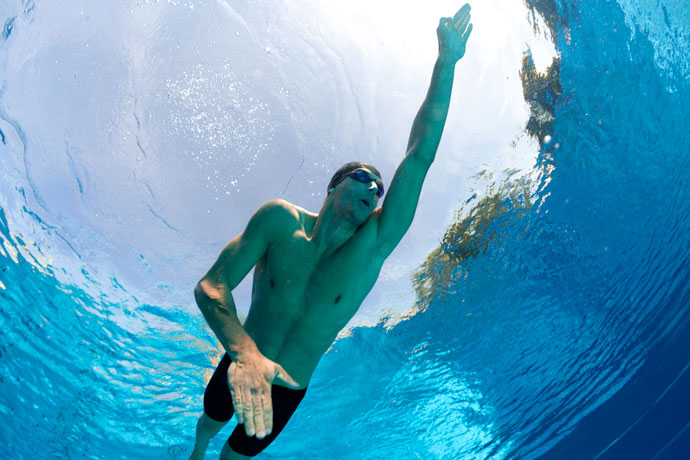
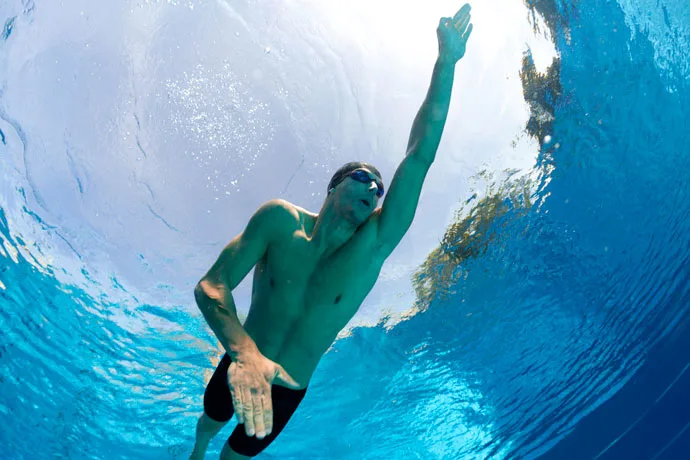
The following video shows a slow-motion recording of Michael Phelps.It is a nice demonstration of the correct arm movements:

You can see that the arms in the front crawl perform alternating movements. While one arm pulls backward in the water, the other arm recovers forward above the water.
There’s more on this below.
Swim Stroke Phases
The different phases of the arm stroke that one can observe in good front crawl swimmers follow:
- Downsweep
- Catch
- Insweep
- Upsweep
- Release
- Recovery
- Entry and Extension Forward
Downsweep
To begin our discussion, we should imagine that one of the arms is extended forward underwater at the end of its recovery.
The other arm has started its propulsive phase. The body is rotated downward on the side of the extended forward arm.
The wrist is slightly bent to start the downsweep. The elbow bends but is kept high in the water. As a result, the forearm moves down and backward until the underside of the forearm and the palm face backward.
The upper arm moves a little bit outward, which makes it easier to keep the elbow high in the water.
The downsweep should be performed quickly. However, you should not exert any force with your arm during this phase, as this only pushes water downwards, wasting energy and creating resistance.
Catch
At the end of the downsweep, the shoulder, elbow, and hand are positioned on the same vertical plane.
The shoulder is at the top while the hand is at the bottom, between 20-28 inches (50-70 cm) deep.
The elbow is bent about 90° and maintains this angle during the subsequent propulsive phases of the arm stroke.
The underside of the forearm and the palm are now facing backward and slightly outward.
This is the so-called high elbow catch.
Insweep
The insweep is the first propulsive phase of the arm stroke.
Once the arm is positioned at the catch, the upper arm is moved in toward the rib cage while the elbow maintains its angle, and no rotation takes place in the forearm.
The arm is moved as a single unit like a large paddle.
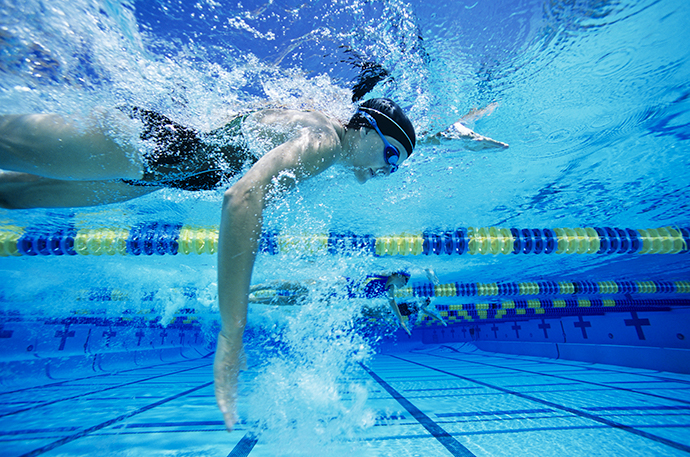
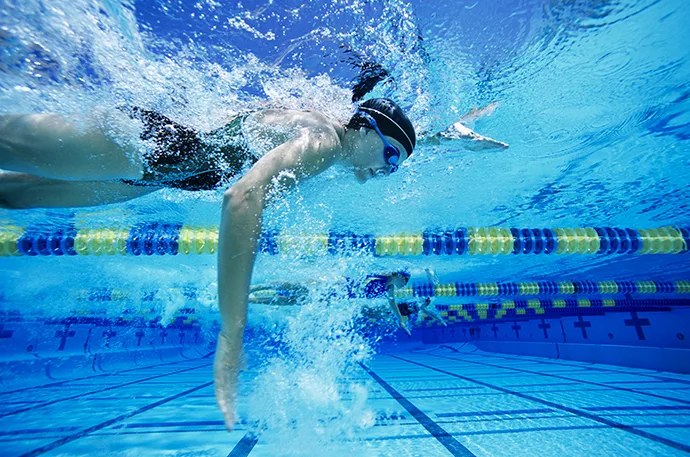
As a result, the forearm and palm move inward, upward, and backward due to the adduction of the upper arm.
The body rotates upward to the side of the arm sweeping in.
The insweep ends once the upper arm is close to the rib cage, and the hand is below the chest and close the midline of the body.
Upsweep
This is the second and most propulsive phase of the arm stroke, during which the direction of the arm movement changes.
At the beginning of the upsweep, the forearm rotates so that the underside of the forearm and the palm now face backward, upward, and outward.
The hand then moves from below the chest backward, upward, and outward toward the hip.
The elbow remains slightly flexed so that the palm and forearm remain facing backward as long as possible.
Release
No force should be applied at the end of the upsweep, as the forearm and hand move primarily upward.
Otherwise, water would be pushed up, which increases drag and pushes the hips down.
The shoulder, upper arm, and elbow exit the water in this order, followed by the forearm and hand with the palm turned inward to minimize drag.
Recovery
The arm is brought forward over water, with the elbow leading and the forearm relaxed and dangling.
The recovery should be compact, meaning that the hand hovers above the water and slides close past the rib cage.
During arm recovery, the arm should be kept relatively relaxed. However, the momentum built up during the upsweep should be used to bring the arm forward quickly.
Entry and Extension Forward
Once the hand has passed the head, it enters the water with the fingertips first.
The rest of the arm moves through the hole opened by the hand in the water and continues to move forward underwater until it is fully extended.
The arm stroke cycle can then begin anew.
Ideally, the forearm is held in a neutral position, neither turned outwards nor inwards during the entry into the water.
This causes less tension in the shoulder and means that all fingers except the thumb enter the water at about the same time.
Timing of the Arms
The timing between the movements of both arms is very precise: While one arm dives into the water in front of the head and then extends forward underwater, the other arm completes its propulsive insweep phase.
Timing of the Arms and Legs
The timing between the arm and leg movements is also very precise.
Whether you use a two-beat kick or a six-beat kick, the downsweep of the propulsive arm and the downbeat of the leg on the same side always start at the same time.
Conclusion
This wraps up our discussion of the arm movements of the front crawl stroke. More information about the arm movements in the front crawl stroke can be found in our article Swimming Technique–Tweaks and Mistakes.
References
- Maglischo, E. (2003). Swimming Fastest. Champaign, IL: Human Kinetics, pp. 103-117.
Related Pages
You may also be interested in the following articles that cover the front crawl’s swimming technique:
Joshua
Monday 22nd of January 2024
I thought this as true and interesting and it has helped me in my swimming.
Sidi mohamed
Thursday 7th of March 2019
This is a great job, and useful. Thanks so much.
Alexey Filippov
Tuesday 13th of June 2017
Is this statement in "Swim Stroke Phases" section correct?
Synchronization between arms and legs.
The timing between arm stroke and leg kick is also very precise.
Whether you use a two-beat kick or a six-beat kick, the downsweep of the propulsive arm and the downbeat of the leg on the same side always starts simultaneously.
Christophe
Friday 23rd of June 2017
Yep :-)