
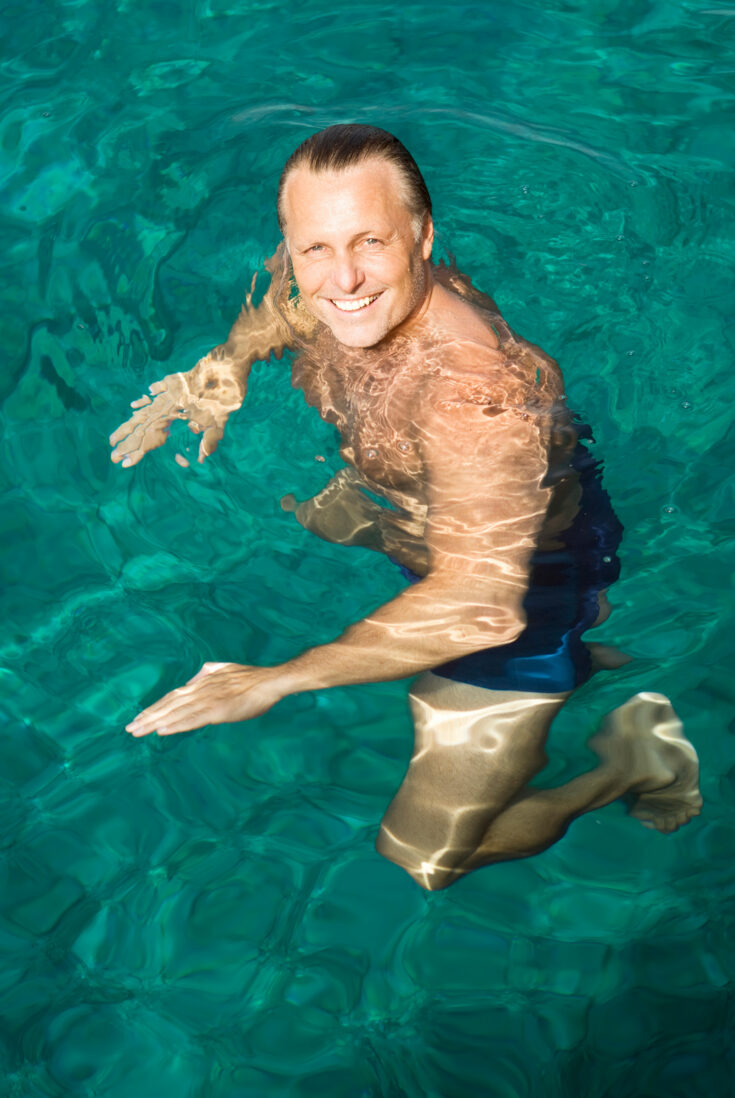
When you tread water, you move your arms and legs to keep your body upright and your head above water.
It is an important skill that beginners must master in order to be safe in the water.
Once you know how to tread water, your water confidence will greatly improve.
Uses
Treading water is a basic swimming technique used primarily to pause for a moment in the water, rather than for propulsion. It is useful in many situations, for example:
- While practicing a specific drill, if you get out of breath, swallow water or lose your rhythm, you can use it to stop in the middle of the water and regain your composure.
- While swimming in open water, you can stop and look around if you lose your bearings.
- If your goggles fog up while swimming, you can stop, take them off, rinse them in the water, put them back on and resume swimming.
Video Demonstration
The following video shows you two different ways of treading water: a popular style and my personal style.
Treading Water – Popular Style
One of the popular techniques for treading water is sculling on a horizontal plane with the arms and fluttering on a vertical plane with the legs.
1) To scull water, raise your arms sideways to shoulder height and then move your arms forward and back, pushing against the water with your hands.
The pressure your arms and hands exert on the water creates some buoyancy that keeps your body afloat.
2) To perform the flutter kick, you alternately kick forward and backward with small quick movements. Your feet point downward as you do this.
The flutter kick also provides some buoyancy, which helps keep the body afloat.
Treading Water – Personal Style
I learned how to tread water as a child, and I don’t remember if I learned this technique on my own or if it was taught by an instructor.
In any case, my technique is less sophisticated, but it works well for me. What I do is the following:
1) I angle my arms at about 90°, with my forearms horizontal and pointing forward, my palms turned downward, and my elbows close to the body.
2) Then, I make circles in the water with my hands. They move down and outward, then up and inward, then down and outward again, and so on.
What I basically do is push the water down with circular movements.
3) My feet also do a circular kind of movement that is similar to the breaststroke kick. The initial position is with my knees bent and my feet in their natural resting position.
4) Then I move my feet down and outward while they go in plantar flexion, then they move up and inward in dorsiflexion.
So what I basically do is push down the water with the inside of my lower leg and foot.
Learning How to Tread Water – Popular Style
To learn how to tread water in the popular style, you can do the following exercises:
1) First, practice the swimming exercises given in the articles about sculling water and the flutter kick.
2) Then, take a swimming pool noodle, put it around your back and under your armpits. Make sure the pool noodle provides enough buoyancy to keep you afloat.
3) Supported by the pool noodle, you simultaneously perform sculling movements with your arms and a flutter kick.
4) Practice these movements until they provide enough buoyancy to keep you afloat even without a swimming pool noodle.
5) When you eventually feel confident enough, remove the pool noodle and try treading water without a buoyancy aid. In the beginning, do this only under the supervision of an experienced swimmer or a lifeguard.
Note: Some instructors use the eggbeater kick as an alternative to the flutter kick, but I think it is more difficult for beginners to learn.
Learning How to Tread Water – Personal Style
To learn how to tread water in my personal style, you can do the following swimming exercises:
1) Practice the breaststroke kick on dry land.
2) Practice the breaststroke kick in the water using floatation aids.
3) Take a swimming noodle, place it around your back, and then under your armpits. Make sure that the pool noodle is sufficient to keep you afloat.
4) Floating in the water in a vertical position, practice the arm movements and the leg movements, first individually and then together.
5) Practice these movements to the point where they provide enough buoyancy to keep you afloat without a swimming pool noodle.
6) Finally, under the supervision of a good swimmer or lifeguard, try treading water without a pool noodle. Do short sets at first, then slowly build up your endurance.
Conclusion
Beginners should spend sufficient time to get good at treading water, as it provides both water confidence and safety. I hope that the information provided in this article will motivate you to master this important basic swimming technique.
Have fun and good luck!
Related Pages
You may also be interested in the following articles that cover basic swimming techniques:
Star
Saturday 7th of July 2018
The proper way to thread in deep water with tiring out too fast.
Starr
Saturday 7th of July 2018
Video and instruction on the proper way to thread in water without getting tired too quickly.
Sam Johny
Tuesday 12th of June 2018
I would like to say that when swimming sometimes when you are nervous, you may thread too fast. This is not good. So remember to calm down.
hamid
Sunday 3rd of September 2017
I'm not very professional in swimming but to tell the truth, I began with your site and then gradually with a similar site and... finally I succeeded!
You maybe ask, what's the success? Very simple: I don't scare of deep part of pool!
I can swim and enjoy the water, swimming and more important of all: I can water treading and the most important "egg beater!"
I really owe you and the other youtube video about swimming.
Now a question please: An amateur (like me), how long should usually be able to do water treading? In other words, "how long" is natural and good for a regular guy?
Obviously, I'm not a young, strong, professional water polo player. Thank you a billion!
Christophe
Sunday 3rd of September 2017
Hi Hamid,
I'm glad that you were able to succeed in learning to swim, being able to enjoy it and now even be able to do water polo! :-)
Now, as for your eggbeater question, I can't give you an answer. I never learned the eggbeater as a child, and a few years ago when I tried to learn it I had to stop because I have some knee issues.
That being said, for the two water treading techniques I show above in the article, I think I can do them for a few minutes at a time without a problem.
Hope this helps.
Reny Boy Alicante
Friday 12th of July 2013
I don't know what am I doing wrong. I still sink after doing those maneuvers.
Christophe
Friday 19th of July 2013
Reny, could it be that you have a low body fat percentage? That could be an explanation of why it is more difficult for you to float.
But with practice, it should be possible for you to be able to tread water using the techniques presented above.
Just practice patiently, it can take quite some time to master the techniques discussed in this article.