
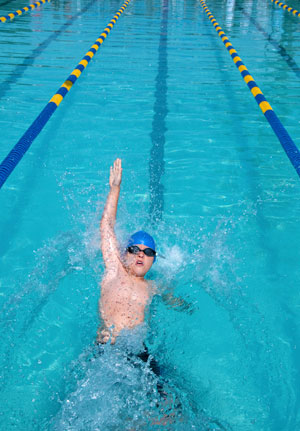
The backstroke, or back crawl, uses alternating and opposite arm movements. As one arm pulls through the water from an overhead position to the hip, the other arm recovers above the water from the hip to the overhead position and vice versa.
The legs perform a flutter kick, similar to the one used in the front crawl.
The backstroke is, as the name suggests, the only one of the four competitive swimming strokes swum on the back.
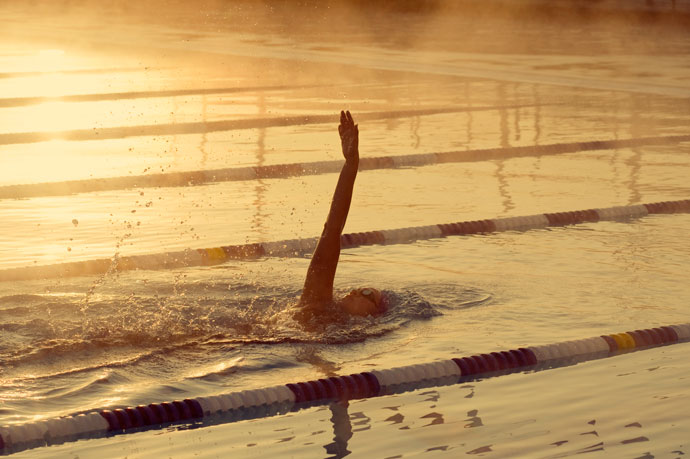
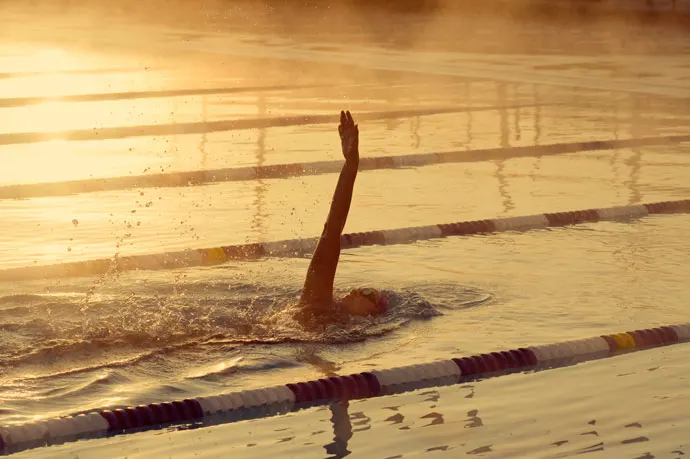
In terms of speed, it is slower than the front crawl and butterfly but faster than the breaststroke.
Backstroke Swimming Video
Below is a video in slow-motion demonstrating backstroke:
Backstroke Swimming Technique
In the next section, we will describe the swimming technique of the backstroke.
Body Movement
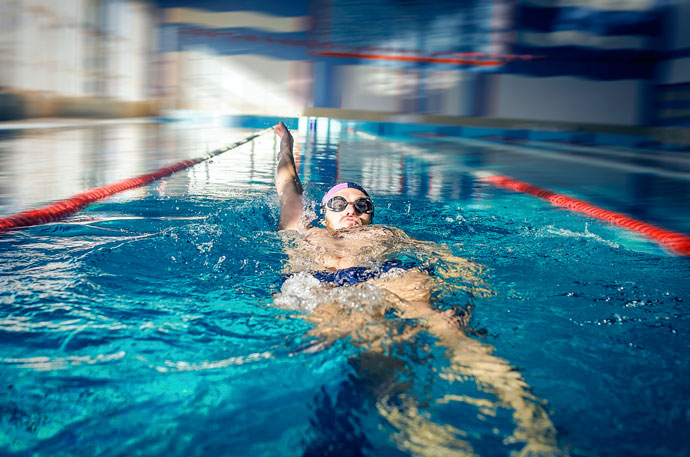
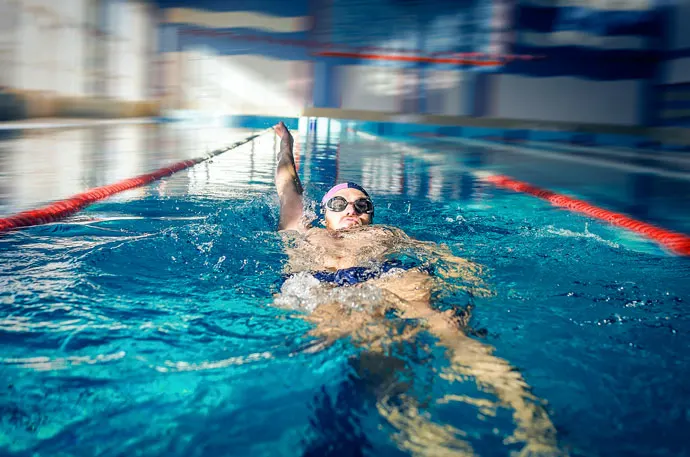
The backstroke is swum in a horizontal position on the back. However, the body rolls a little from side to side, following the arm movements.
As a consequence, the shoulder of the arm that is currently pulling back in the water is lower than the shoulder of the arm that is recovering forward above water.
While the body rolls from side to side, the head remains in a neutral position, face up. Ideally, it should be possible to swim backstroke with a small bottle on your forehead without it falling off.
You can learn more about body movement in backstroke here.
Arm Movement
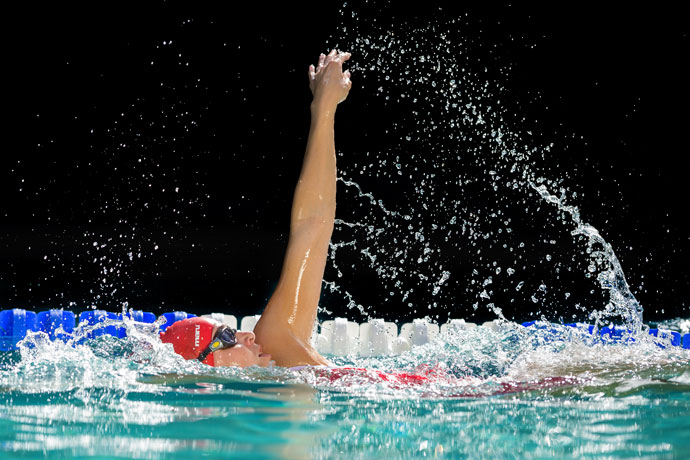
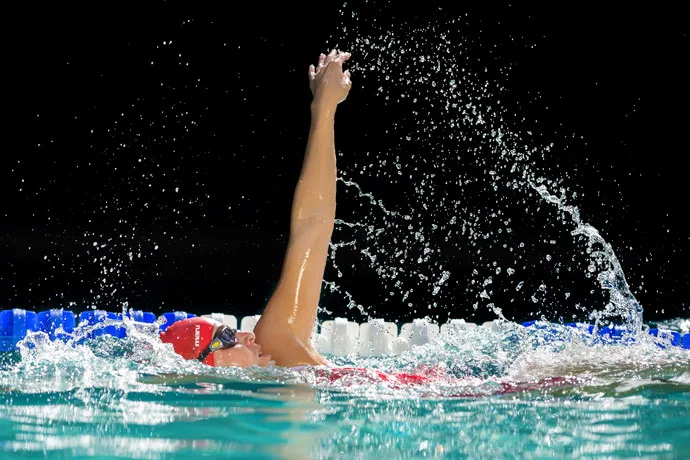
In the backstroke, the arms perform alternating and opposite movements.
One arm pulls backward in the water, from an extended forward position to outside the shoulder and then to the hip, performing an S-shaped movement and providing propulsion.
The other arm recovers above water, moving from the hip to the extended forward position in the water, performing a semi-circular movement. The arm is kept straight during the recovery.
The arms then alternate their movements, and so on. Per swimming stroke cycle, each arm pulls once in the water and recovers once above the water.
You can learn more about arm movement in backstroke here.
Leg Movement — Flutter Kick
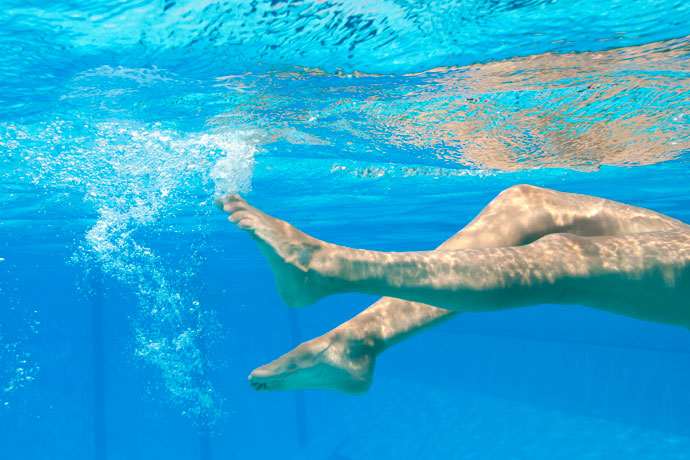
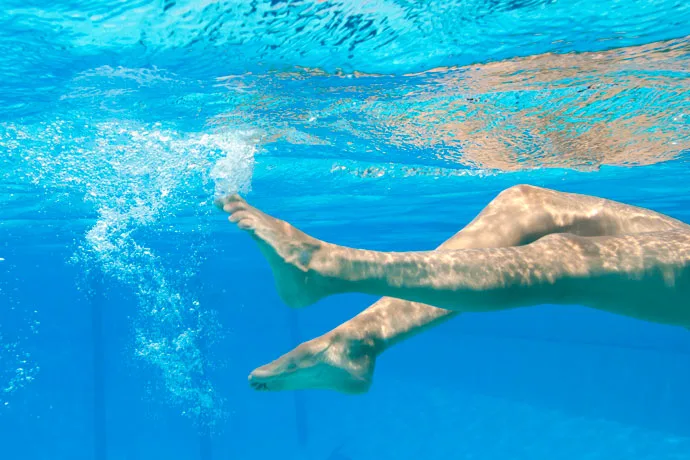
The backstroke uses a flutter kick. The legs perform alternating and opposite movements. While one leg moves up, the other leg moves down, and vice versa.
The legs are moved up and down in quick succession with compact movements. The feet are stretched while the hips and knees bend slightly.
In backstroke swimming, a six-beat kicking pattern is used almost universally, with each foot kicking three times per stroke cycle, for a total of six kicks.
The flutter kick provides some propulsion in addition to the propulsion generated by the arms. The kick also helps to stabilize the body in relation to the arm movements.
You can learn more about the flutter kick in backstroke here.
Breathing Technique
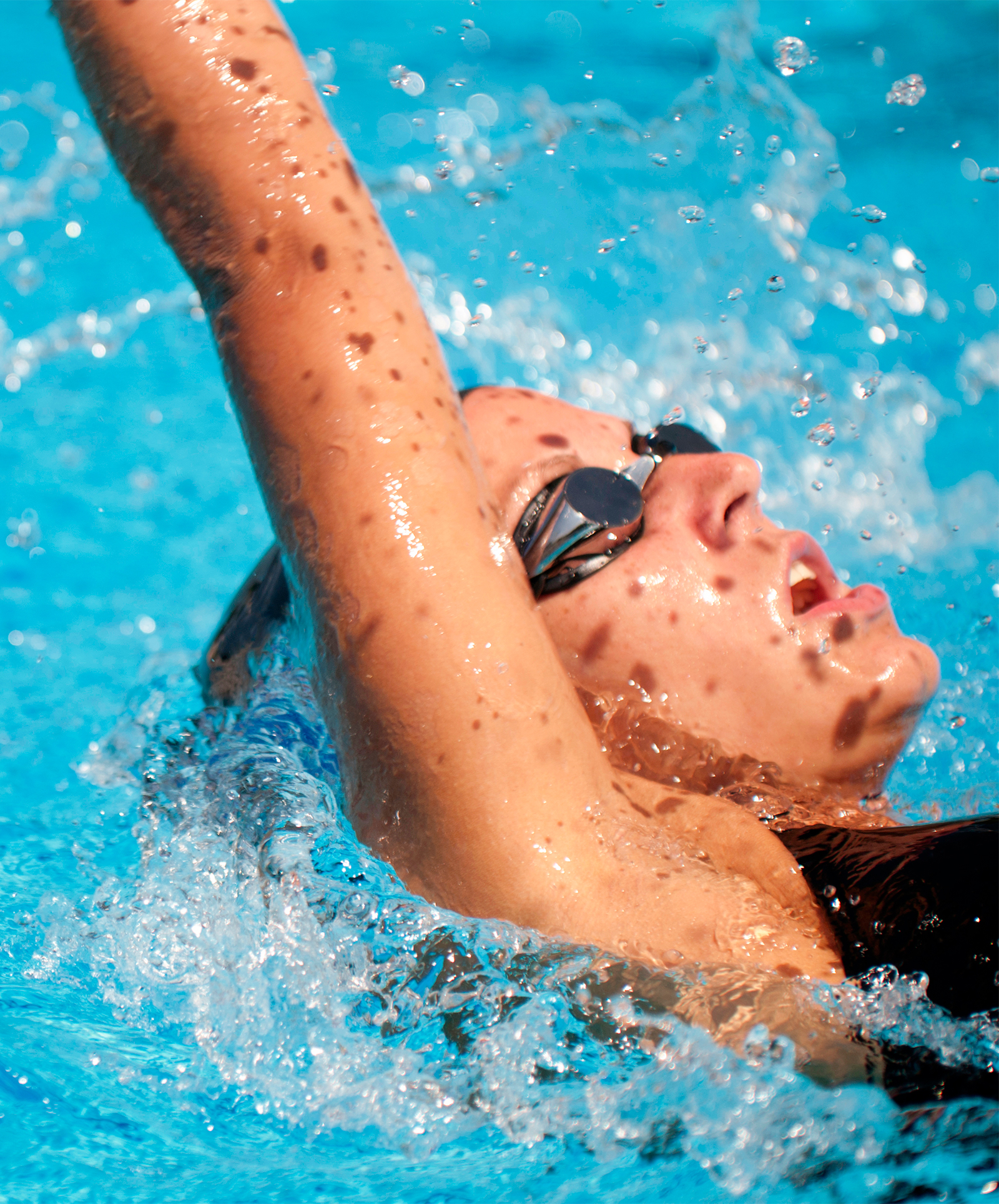
Breathing is not restricted when swimming backstroke, because you are on your back and your face is above the water.
However, this requires that you have a relatively good balance in the horizontal position on your back. Otherwise, it is possible that the head will submerge, which, of course, leads to problems.
It is also possible for water to splash into the face during the recovery of the arm stroke. Therefore, it makes sense to synchronize breathing with the movement of the arms.
For example, you can always inhale on one arm while exhaling on the other arm if it is always the same arm that splashes water in your face.
Or inhale during the ascending part of the arm recovery and exhale during the descending part of the arm recovery.
You can learn more about breathing during the backstroke here.
Learn to Swim Backstroke
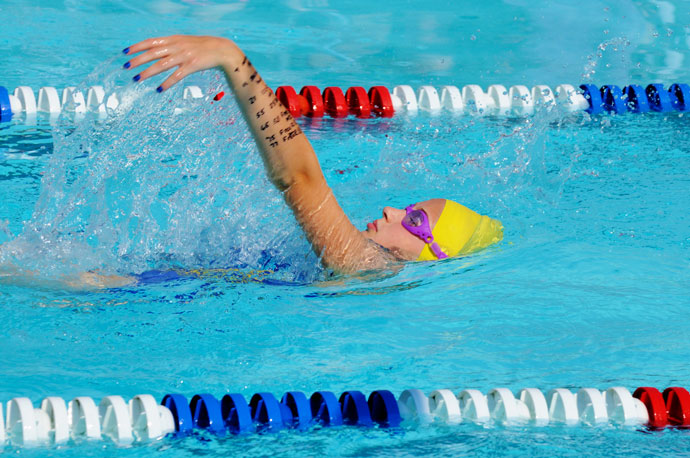
With our series of swimming drills, you can learn the backstroke step by step. The series can be divided into the following stages:
1) First, you practice the flutter kick on your back while holding on to the edge of the pool.
2) Next, you practice balance by floating on your back and sides and using the flutter kick to move forward.
3) Then you practice the underwater and above water arm movements separately with each arm.
4) Finally, you practice both arm movements simultaneously.
Go to our series of swimming drills for backstroke.
How to Avoid Bumping into the Wall
The problem with the backstroke is that you cannot see what is happening in front of you. That’s why our reader, Suzanne, is afraid to bang her head into the wall at the end of the pool.
This is a legitimate fear to have and especially so for beginners. Therefore, I describe some strategies you can use to avoid swimming into the wall.
Elementary Backstroke
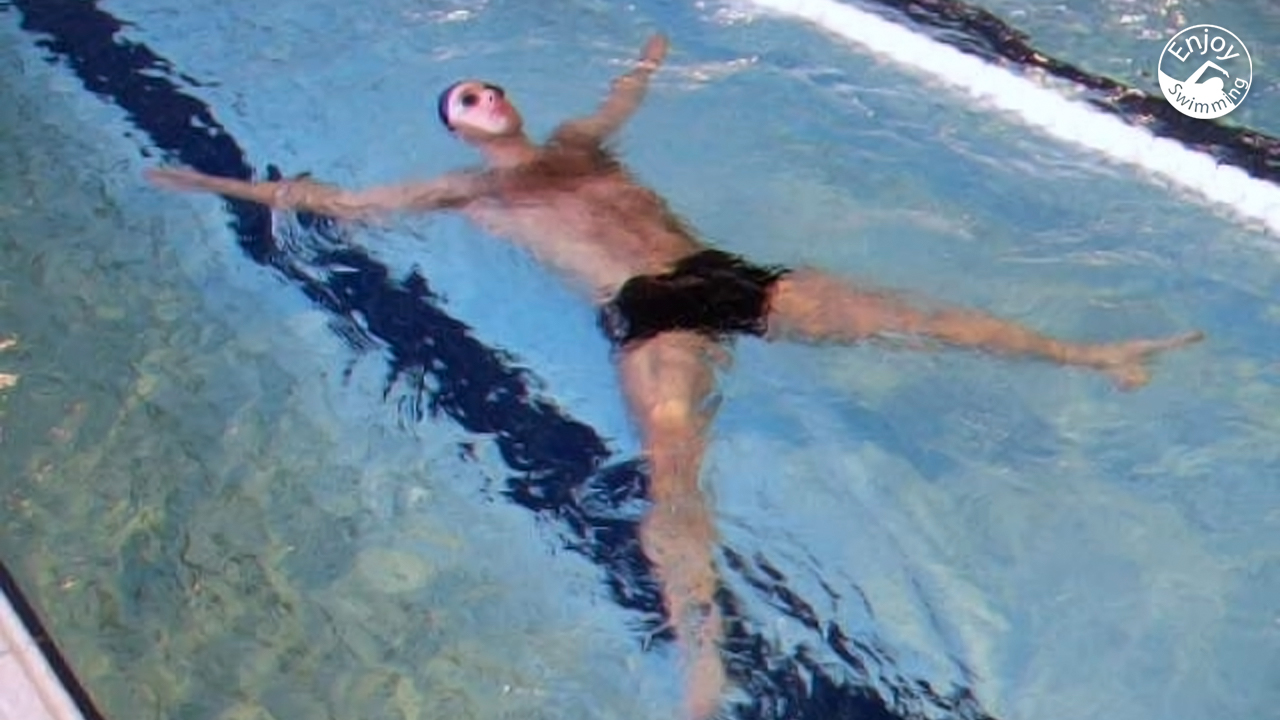
Elementary backstroke is a simplified form of backstroke that is easier for beginners to learn.
Body Movement
The body is in a supine position in the water. This enables unrestricted breathing. However, it is necessary to have a reasonably good balance on the back.
Arm Movement
The arms perform identical and synchronous movements in the water.
At first, the arms are straight along the body. The hands are drawn from the hips, along the body to the armpits, then moved outwards at shoulder level until the arms are straight and extended sideways.
Finally, the straight arms are moved back to the hips, pushing against the water and thus providing propulsion.
Leg Movement
The legs also perform identical, synchronous movements in the water, that are similar to the breaststroke kick, except that the body is turned up instead of down in the horizontal position.
At first, the legs are stretched out and held together. Now, the knees bend, the legs are spread, and the feet move toward the buttocks.
When the feet are close to the buttocks, the legs are extended again and brought together. Thereby, the inner sides of the legs and feet press against the water and provide propulsion.
Breathing
Breathing is unrestricted, but it makes sense to synchronize breathing with the arm and leg movements, i.e., inhale when the arms move toward the shoulders and extend sideways, and exhale when the arms are brought back to the sides.
You can learn more about the elementary backstroke here.
Related Pages
You may also be interested in the following articles that cover the backstroke’s swimming technique:
Dwi Yugi
Wednesday 16th of August 2023
My favourite stroke among all.
Gabriele Muellenberg
Tuesday 11th of September 2012
The backstroke swim style helps when you recover from most back surgery, as well. I had part of my lower spine fused and found backstroke the most comfortable way of being in the water.
However, I was always good at backstroke. Meantime, it took me 10 years to feel 100% in the water.
I shouldn't take on big waves ever again, though. Doctors orders. I know it is true, as a spine which is not totally elastic anymore is not to be taken lightly.
However, swimming is still one of the best sports after surgeries. Mind that physiotherapy in the swimming pool is tops for the same reason.
dennis b
Sunday 18th of December 2016
Thanks for the tip.
I have been swimming freestyle for years. I had 2 back surgeries. Trying the backstroke is hard because I also had neck surgery.
Any tips?
Dennis