
Hip-Delay Butterfly is a swimming drill to practice when learning the butterfly stroke. In this drill, you focus on the movements and timing of the arm recovery above water.
Hip-Delay Butterfly follows Stoneskipper and precedes Body-Dolphin Butterfly in our series of swimming drills for the butterfly.
After completing this drill, you will have practiced all the movements required to swim the butterfly stroke.
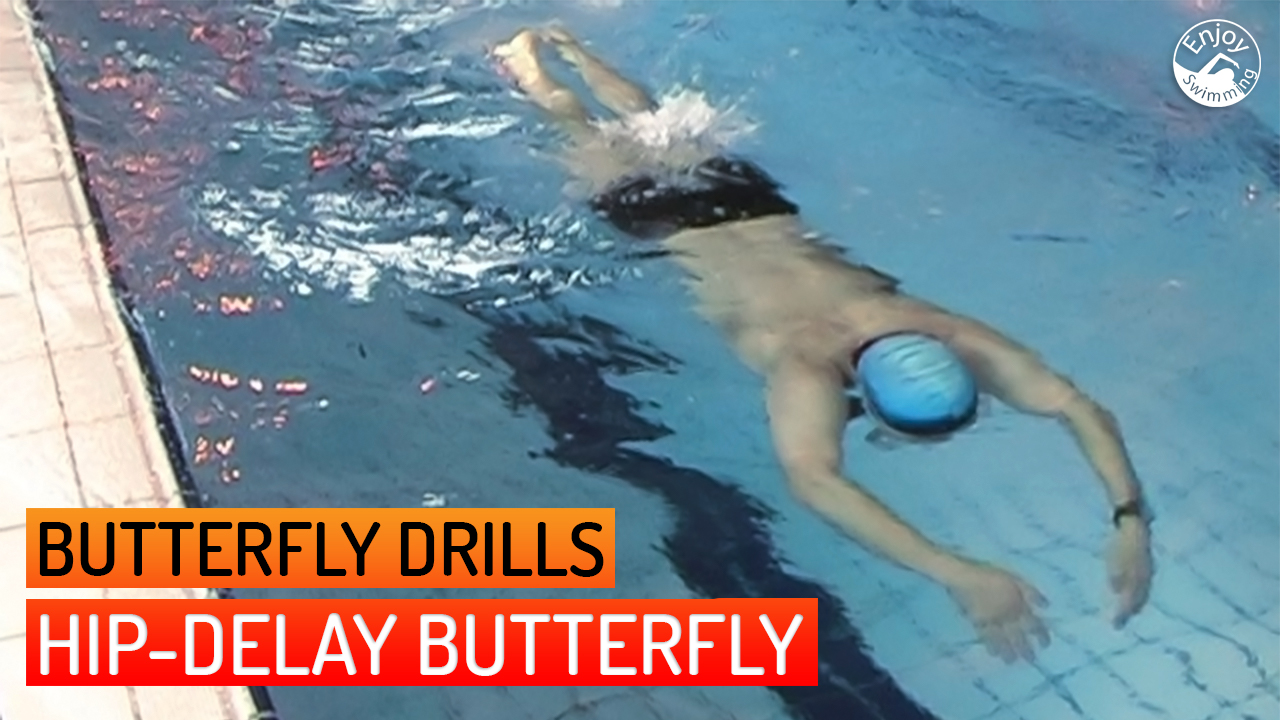
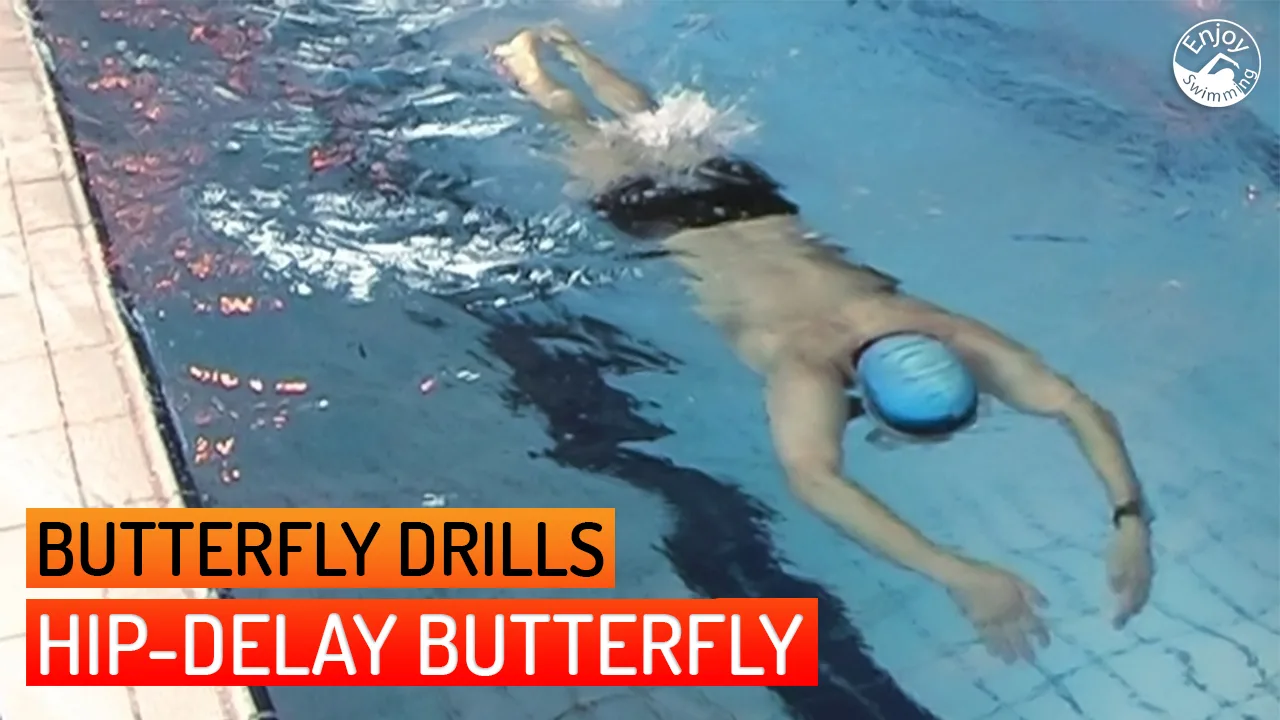
Video Demonstration
The following video illustrates the Hip-Delay Butterfly drill:
Swimming Drills Instructions
As you can see above, in Hip-Delay Butterfly, you perform all the movements of full-stroke butterfly, except for one thing: you don’t execute the whole arm stroke at once. Instead, you split the movement up and introduce delays in the form of additional body dolphins.
What to do:
- Push off the wall in a face-down position with your arms stretched out in front of you and your hands close together.
- Perform two hand-lead body dolphins.
- At the end of the second body dolphin, slide your hands to the corners and perform the underwater component of the arm stroke with breathing, as practiced in the Stoneskipper drill.
- After taking a breath and completing the underwater arm stroke, your upper body will probably have sunk a bit.
- Perform two head-lead body dolphins with your arms at your sides to get your upper body – and especially your shoulders – close to the water’s surface again.
- As you release your chest and push your hips down at the end of the second body undulation, lift your arms out of the water and recover them forward in a swift, semi-circular movement.
- Drop your arms in the water in front of you and extend them fully underwater to begin another drill cycle.
Additional Tips
Timing the arm recovery correctly takes practice. You need to synchronize the beginning of the arm recovery with the body undulation, when the chest is being released, the shoulders are close to the surface and the hips are being pushed down.
If your shoulders are too deep in the water, lifting your arms out of the water will be impossible. To avoid this problem, do not make your body undulations too deep. The deeper you push your chest down in the water, the harder it will be to lift it back to the surface to perform the arm recovery.
In the beginning, it will take several body undulations to bring your upper body back to the surface after performing the underwater arm stroke. With practice, it will become easier, and you will need fewer undulations. Aim for two hand-lead and two head-lead undulations.
A mistake beginners commonly make at the beginning of the arm recovery is trying to lift their arms out of the water upwards in a straight line. This will be difficult to do, if not impossible. The correct movement is to sweep the arms simultaneously upward and sideways out of the water.
Perform the arm recovery swiftly, but stay relaxed as you do so.
You raise your head and shoulders above the water’s surface while performing the underwater arm stroke, which allows you to breathe in.
On the other hand, your face will remain in the water for the rest of the drill cycle, and consequently you will need to exhale in the water, preferably in a controlled and continuous manner.
Learning Path for the Butterfly Stroke
Below is an overview of our series of articles on learning the butterfly stroke. Each article in this series contains one or more drills that have to be mastered. The current article is highlighted:
Once you have gone through all the steps of this learning path, you should be able to swim butterfly without any problems.
Good luck!